Facebook launches Marketplace for local buying and selling

A man is silhouetted against a video screen with an Facebook logo as he poses with an Samsung S4 smartphone in this photo illustration taken in the central Bosnian town of Zenica, August 14, 2013. REUTERS/Dado Ruvic/File Photo

A man is silhouetted against a video screen with an Facebook logo as he poses with an Samsung S4 smartphone in this photo illustration taken in the central Bosnian town of Zenica, August 14, 2013. REUTERS/Dado Ruvic/File Photo

Facebook Inc launched Marketplace to allow people to buy and sell items locally as the social media network tries new ways to keep users engaged.

The feature will appear as a “shop” icon at the bottom of the Facebook app and will allow users to list or search for items on sale in their neighborhood.

The company will not facilitate the payment or delivery of items and will not take a cut from any transactions, Facebook said.

The new service will be rolled out in the United States, the UK, Australia and New Zealand for iPhone and Android users over the next few days, the company said in a blog post, adding that the feature will be available on the desktop version in the coming months.

More than 450 million people already visit Facebook groups that have items to buy and sell each month, the company said.

Last year, Facebook said it was testing several ad features that allow users to shop directly through its app, an effort to move further into e-commerce.

Facebook’s shares were little changed at $128.39 in morning trading on Monday on the Nasdaq.

Source: Reuters

Waze just got a ‘lot’ better

What a waste: Drivers waste up to 55 hours a year looking for somewhere to park their car. — AFP Relaxnews

What a waste: Drivers waste up to 55 hours a year looking for somewhere to park their car. — AFP Relaxnews

Popular navigation app Waze is teaming up with INRIX to take the stress out of finding a parking lot a lot closer to your final destination.

It doesn’t matter how good the active safety and assistance features are on current cars if you can’t take advantage of them. A host of 2016 model-year vehicles can park themselves in a parallel or perpendicular space while simultaneously keeping an electronic eye out for on-coming traffic.

However, if you can’t find a parking space in the first place, the systems are redundant. And according to the latest Frost and Sullivan data, the average driver is currently wasting 55 hours a year looking for a parking space and that equates to a staggering US$600mil (RM2.48bil) in lost time and burned fuel in the US and Europe.

Waze already offers a list of parking lots sourced from its user community but by partnering with INRIX the app will now have a comprehensive list of facilities throughout Europe and North America.

“Driving from point A to B is only part of the journey,” said Alex Israel, vice president and general manager of parking at INRIX. “The addition of INRIX Parking enhances Wazers’ end-to-end driving experience.”

INRIX is one of the world leaders in connecting cars and is leveraging that information for insights on everything from congestion to parking. Its technology is appearing as standard in a host of carmakers’ ranges, from BMW to Volvo.

This initial coming together will only provide Waze users with navigation to car parks closest to their destination, but INRIX also has dynamic solutions that offer real-time information about pricing and use – i.e., how many spaces are available at a facility – plus algorithms that can calculate which on-street parking areas are the most and least likely to be in use.

“Driving around looking for spots impacts arrival times and adds unneeded frustration and stress to the entire driving experience,” said Flavia Sasaki Siqueira, Head of Business Development for Waze.

“Combining INRIX parking information with our own parking database expands reach and accuracy of the ‘where to park’ feature.” — AFP Relaxnews

Source: The Star Online

Grab raises $750 million to take on Uber in Southeast Asia

Commuters wait for a train next to Grab transport booking service app advertisements at a train station in Singapore February 10, 2016.REUTERS/Edgar Su/File Photo

Commuters wait for a train next to Grab transport booking service app advertisements at a train station in Singapore February 10, 2016.REUTERS/Edgar Su/File Photo

Grab, the biggest rival to ride-sharing service Uber Technologies Inc [UBER.UL] in Southeast Asia, has raised $750 million in a funding round, turning up the heat on the U.S. firm now seeking to expand in the region after exiting China.

The successful cash-injection just a month after Indonesian peer Go-Jek raised $550 million highlights the intensifying competition in the region, as Uber shifts its focus following a deal to sell its China operations into Didi Chuxing.

Four-year-old Grab said it planned to expand its services in Southeast Asia through the funding round, which was led by Japan’s SoftBank Group (9984.T) with new and existing investors.

The region has become a key battleground for ride-hailing firms thanks to a burgeoning middle class as well as a youthful, internet-savvy demographic.

Since leaving China in August, Uber is even more focused on Southeast Asia, doubling down on resources, staffing and technology deployed there, a source familiar with Uber’s plans has said.

Specifically, the company is refocusing more than 150 engineers to work on its Southeast Asian operations and hiring more engineers in India, the source said. It was also working on making sure its maps fit the region.

The latest funding values Grab at over $3 billion, a source familiar with the matter said.

It increases its total capital position to over $1 billion, the company said without naming other investors in the round. A Grab representative told Reuters institutional investors from the United States and China took part.

Uber had no comment on Grab’s fund-raising.

BUFFERING

Grab says it has 95 percent market share in third-party taxi-hailing services, while its private-car business has more than half of the Southeast Asian market.

In addition to expanded ride-hailing services, Grab said it planned to invest in mobile payments capabilities in a region with low banking and credit card penetration and limited cashless payment options.

“Grab is using this funding to try to diversify because the ride-hailing industry, in terms of profitability, is still a big question. Grab need to hedge risks and diversify,” said Rushabh Doshi, an analyst with researcher Canalys.

Source: Reuters

Huawei replaces Xiaomi at top of Chinese smartphone market

The most recent numbers out of analyst firm IDC show a major shakeup in the Chinese smartphone market for Q2. During an especially rough quarter, local handset maker Xiaomi’s shipment dipped significantly from 17.1 to 10.5 million year over year, according to the firm.

The 38 percent drop was enough to knock the company down to the fourth position, as Huawei took over the top spot with 19.1 million units moved, comprising 17.2 percent of the country’s massive market share. Huawei was followed closely by fellow domestic manufacturers OPPO and Vivo, at 18 and 14.7 million units, respectively.

For its part, Xiaomi has disputed IDC’s numbers, pointing to higher estimates from other prominent research firms, though all noted numbers significantly below Q2 2015’s 17 million.

The highest spot by a non-domestic company on IDC’s list was secured by Apple, which rounded out the top five with 8.6 million shipments, also down fairly significantly (31.7 percent) from 12.6 the year prior.

Source: TechCrunch

Indonesia will be Asia’s next biggest e-commerce market

Indonesia, Jakarta, View of city during sunset

Indonesia, Jakarta, View of city during sunset


Indonesia presents much opportunity for e-commerce among other emerging Asian economies, with current projections putting this archipelago nation’s e-market at $130 billion by 2020 (coming third behind China and India). With an estimated annual growth rate of 50 percent and strong mobile-first initiatives, retailers have a unique opportunity in Indonesia to focus on developing truly mobile platforms to help facilitate e-market growth, particularly in the consumer packaged goods (CPGs) sector.

Indonesia’s current e-commerce market is similar to China’s online marketplace beginnings, with a large pool of entrepreneurial sellers providing goods purchased based largely on social media recommendations. Similarly, e-commerce in Indonesia also mimics the early U.S. e-market, which was flooded with customers wary to trust online payments and retailers. Indonesia is truly unique in that it has the potential to create a hybrid of the widest opportunities from America and China’s e-commerce economies, propelling the Indonesian online marketplace onto the global stage.

Read more: TechCrunch

Food startup Deliveroo raises $275M


Deliveroo, a popular on-demand restaurant food delivery startup in Europe, has raised another $275 million in funding, a Series E investment that we have heard from sources values the company at around $1 billion. This latest round is led by new investor, Bridgepoint, previous investors DST Global and General Catalyst, and also had participation from existing investor Greenoaks Capital.

Deliveroo says the investment will go into growing its service in both new and existing markets, where it’s now live in 84 cities. It’s also going to keep investing in its new initiatives. These include a new B2B remote kitchen service, RooBox, which gives restaurants access to delivery-only kitchens in key locations. Other new services have included an expansion into alcohol delivery.

Deliveroo, which is not confirming its valuation, has now raised $475 million to date.

This latest funding comes at a time when the startup is facing a lot of heat from others who are also targeting the higher, foodie end of the prepared food market (typical Deliveroo restaurants include artisanal pizza and burger joints, trendy Middle Eastern delis, and hipster donut bakeries).

Rivals include Uber, which has stormed into Europe with UberEATS, as well as others like Delivery Hero and Just Eat, and now, it seems, Amazon too (whose own food delivery project in Europe is currently codenamed “Hot Wheels”).

The intense competition in the market has led to a distinctly sink-or-swim climate, with other hopefuls like Take Eat Easy closing down last week after failing to raise money.

Sky News reported news of Deliveroo’s round earlier today, and we have confirmed the details with Deliveroo directly.

“After seeing strong growth in the markets we launched in November, our new focus is to drive further innovation in food delivery,” founder and CEO Will Shu said in a statement. “In particular, I’m excited about exploring completely new ways to solve the hardest problems restaurants face when offering delivery. RooBox is the first illustration of this approach, and innovations like these are at the heart of our mission. We’re proud and honoured to have the support of Bridgepoint, DST Global and General Catalyst in this endeavour.”

We had been hearing about Deliveroo’s attempts to raise this round for months now, and our information came with several other interesting details.

For one, we were told that this round has been taking some time to close — nine months, by one person’s estimate — as the size and terms have fluctuated.

Also, multiple sources allege the company had hired Morgan Stanley either to help arrange financing for this deal, or potentially to find a buyer for the company. Among those that were approached as potential buyers or partners: Uber, Delivery Hero, Amazon, Just Eat and Takeaway.com.

To be clear, Deliveroo denies conversations about partnerships or acquisitions and says that the round was oversubscribed.

Deliveroo, meanwhile, has been growing. It says that since its last round of funding ($100 million in November 2015), it has grown 400 percent and “reached profitability in a number of its established markets,” which would include London. It has also added 29 new cities and 9,000 new restaurant partners to its footprint in the last eight months.

And if we’re in a sink-or-swim climate at the moment, for now competitors are just happy to see Deliveroo seal the deal, since rising tides will help lift all (remaining) boats. “It’s good news that they managed to finally close,” another food delivery founder told me. “I think everyone was nervous it would be one of Europe’s largest failures… It would have affected the whole industry.”

Notably, Uber opted to partner up and sell off its operation in China to arch rival Didi Chuxing after it proved too costly to compete against it. Whether that might be a precedent for other geographies and categories beyond basic transport remains to be seen.

For now, there has been a lot of competition between Deliveroo and UberEATS in markets like London, not just to secure restaurants for delivery and to find loyal customers, but also to pick up drivers to complete orders.

Anecdotally, drivers we’ve interviewed who have made the leap to Uber from Deliveroo tell us the pay is better — meaning Uber’s competing by sacrificing margin to gain market share.

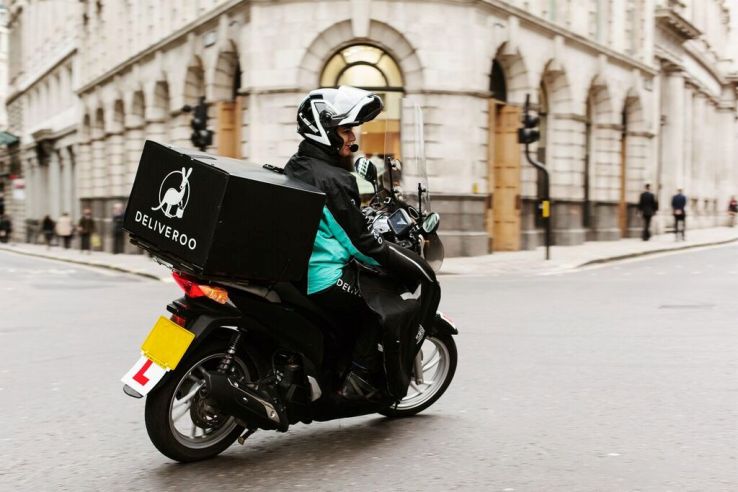
Confusingly (or serendipitously?), the green-lettered black delivery boxes for UberEATS and Deliveroo look nearly identical.

Deliveroo says that since its Series D, it has added 6,500 new riders to its network.

Source: TechCrunch